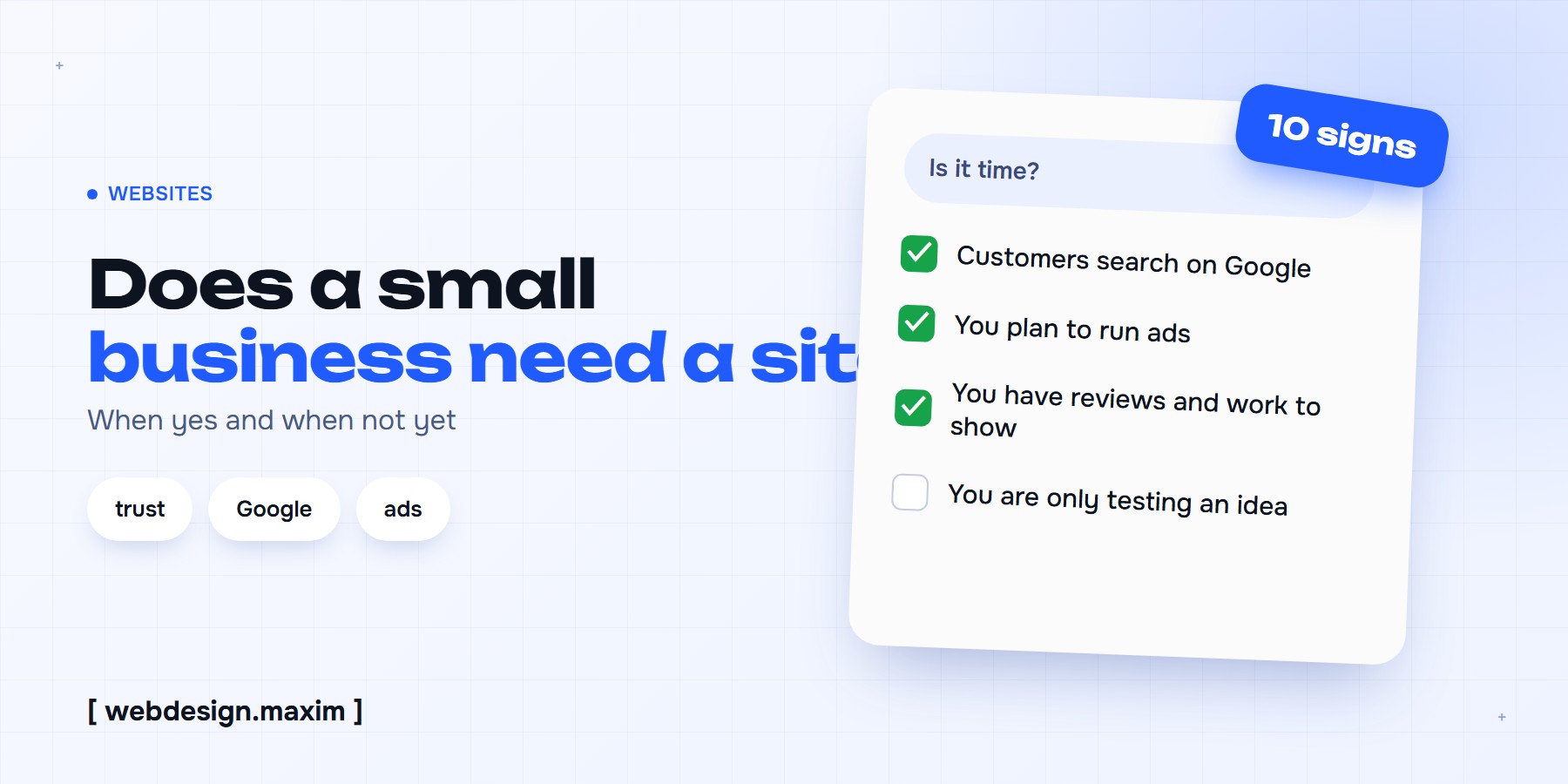
Does a Small Business Need a Website: When You Can Do Without and When It's Already Necessary
Does a small business need a website: 10 signs it's time to build one, when Instagram is enough, which format to choose and how much it costs (from $150).
Does a small business need a website: the short answer
Yes, but not always from day one. A small business needs a website when you have something to show and sell: services or products, first customers, examples of work, reviews, and you want to receive inquiries from Google and ads rather than depend only on Instagram, Telegram or marketplaces. If you’re still testing an idea and have no clear product, you can start with simpler tools.
Below: when you can do without a website, when it’s already necessary, which format to choose and how much it costs. The author is me, Maxim: I’ve built more than 60 sites for small and mid-sized businesses in Ukraine, Europe and the US.
Does a small business really need a website if it has Instagram?
This question constantly comes up for small business owners, especially when they already have Instagram, Facebook, Telegram, OLX, Prom, a marketplace or customers come through referrals. It seems: customers are already coming, the site can wait. Sometimes that’s really true.
But a website is a business’s own platform. It builds trust, explains services, shows examples of work, collects inquiries from Google and ads and reduces dependence on social networks, whose rules change without your involvement. So the right question isn’t “does everyone need a website?” but “at what stage will a website become useful for my business?”.
When a small business can do without a website
If you’re only testing an idea and don’t yet have a clear product, a stable service or an understanding of your audience, start with simpler tools: Instagram, Telegram, Google Business Profile, a marketplace. A website can wait if:
- you’re only testing demand;
- you don’t have photos, descriptions, case studies or reviews yet;
- customers come only through personal referrals;
- you have no budget for proper development;
- you aren’t yet planning advertising or SEO;
- your range or services change often.
In that case, first sort out your offer: what exactly you sell, to whom, at what price and what problem you solve. Once you have the answers, it will be time for a website.
When you already need a website: 10 signs
If 3–4 items or more match, it’s worth building a website now:
- customers often ask the same questions;
- services need explaining in more detail than in posts;
- you have several lines of work;
- you want to run ads;
- you need to promote on Google;
- you have a portfolio or case studies worth showing;
- you have reviews that confirm quality;
- you want to look more reliable than competitors;
- customers search for your service;
- Instagram no longer covers all the tasks.
A beauty salon, a cleaning company, a workshop, legal services, a manufacturer, a store or a local service all get more trust and more inquiries from a website. Examples of such projects are in my portfolio: from the kids’ furniture store “Tatova Stolyarnia” to the site of the kitchen manufacturer Sinenko Furniture in Poltava.
A website helps build trust
For a small business, trust is one of the main sales factors. Seeing a company for the first time, a person wants to understand: who you are, what you offer, whether you can be trusted, what your work and reviews are, how to contact you and whether the business looks professional. Social networks show this only partly, while a website collects everything in one place: services, benefits, the work process, portfolio, reviews, contacts, FAQ and an inquiry form.
That’s exactly why on my site customer reviews are placed prominently.
A website works as a business presentation
Instagram and Telegram show a business through posts, stories and messages, but it’s inconvenient to look up specific information there. On a website everything is laid out logically: the home page for the essence of the business, the services page for what exactly you do, the portfolio for examples, reviews for proof of trust, FAQ for answers to common questions, contacts for an easy way to get in touch. You no longer explain the same thing to every customer by hand: you can just send a link.
A website helps you get inquiries from Google
A website’s main advantage is traffic from search. People search “apartment renovation in Vinnytsia”, “cleaning company”, “legal consultation”, “kids’ furniture”, “flower delivery”, “photographer services”, and if you have a site with the right structure, SEO headings, pages for services, text, reviews and contacts, you have a chance of appearing in those results.
It’s important to be honest: a site doesn’t reach the top of Google right away. But without a site you lose this channel completely, and it works every day without constant ad spend. How this is built in at the development stage I describe on the turnkey business website page.
A website doesn’t replace Instagram but complements it
“We have Instagram, why do we need a site?” is the most common objection. But these channels do different jobs:
- Instagram suits live content, news, stories, conversation, showing the process, quick posts and warming up an audience;
- A website suits structure, SEO, trust, advertising, presenting services, a portfolio, inquiries and long-term promotion.
The ideal is when they work together: a person saw you on Instagram, went to the site, studied the services and left an inquiry, or the other way around: found the site on Google and went to Instagram to see live content.
A website is needed for advertising
You can also run ads to an Instagram profile, but a website gives more control: a separate page for a specific service, a clear offer, an inquiry form, analytics, conversion tracking and testing of blocks. A landing page or a service page usually works better than sending people to a social profile, because the person lands straight on the information they need. If you plan advertising, see also my Google Ads setup and management service.
What kind of website a small business needs
A small business doesn’t always need a large, complex website. Choose a format for the current task:
- Landing page: from $150. One main service or offer: turnkey renovation, a consultation, a course, a promotion, a craftsman’s service. Launch in 5 days or more.
- Business website: from $300. Several services, a portfolio, reviews, an “About us” page, a blog, SEO. Launch in 14 days or more.
- Online store: from $300. Selling products online: catalog, product cards, cart, shipping, payment, CRM.
Don’t start with a complex site if the task is simple: build a clear site for the current task, then grow it. The format comparison is covered in detail in the article “A landing page or a business website: which to choose”, and what it costs in “How much a website costs in 2026”. The business card format is explained in “What a business card site is and who needs one”. How much a landing page costs: “How much a landing page costs”.
What a small business website should have
A minimal structure that works:
- a first screen with a clear offer;
- a short description of the business;
- services or products;
- benefits;
- examples of work or a portfolio;
- reviews;
- the work process;
- frequently asked questions;
- contacts and contact buttons.
The main thing is not to overload it: it’s better to have fewer blocks, each answering a real customer question. Which pages you need for inquiries is covered in the article “A turnkey business website”.
Do you need a website if customers come from referrals
Yes, and here’s why. A potential customer was recommended by acquaintances and wants to quickly understand who you are, what your work is, what services you offer and how to get in touch. If there’s a site, they find the answers themselves. The referral brings the person, and the site helps them decide. It confirms the trust the people around you have already built.
When a website may not work
A website by itself doesn’t guarantee results. It won’t work if:
- there’s no clear offer and the first screen is weak;
- the mobile version is inconvenient;
- there are no contact buttons and no trust elements (reviews, examples);
- the text is too generic;
- there’s no SEO and analytics isn’t connected;
- the site isn’t updated;
- there’s no traffic: no search, ads or social networks.
So you need to build not just a “website” but a tool for the business’s task.
FAQ
Do you need a website if you have Instagram?
Yes, if you want to get customers from Google, run ads and not depend on a social network. Instagram and a website do different jobs and work best together.
How much does a website for a small business cost?
A landing page from $150, a business website from $300, an online store from $300. I give the final price after a short consultation and fix it before work starts.
How long does building a website take?
From 5 to 14 days depending on complexity: a landing page usually launches in 5–7 days, a business website or store in 14 days or more.
Will I be able to edit the site myself?
Yes. After launch you get access to the admin panel and can change text, photos and prices yourself. If you need help, I’m available after launch too.
Conclusion
A small business doesn’t always need a website from day one. But if you already have services or products, customers, examples of work and plans to grow, a website becomes an important tool: it helps you look professional, build trust, explain services, get inquiries from Google and ads and not depend only on social networks. It doesn’t have to be big and expensive; the main thing is that it’s clear, convenient on a phone and built for real tasks.
Author: Maxim, a web designer and developer from Vinnytsia. I build turnkey sites for small and mid-sized businesses and work directly, with no managers. More about me and my work.
Not sure if your business needs a website?
Message me on Telegram and I’ll tell you which format fits: a landing page, a business website or an online store, and what a realistic budget is. The consultation is free and carries no obligation.