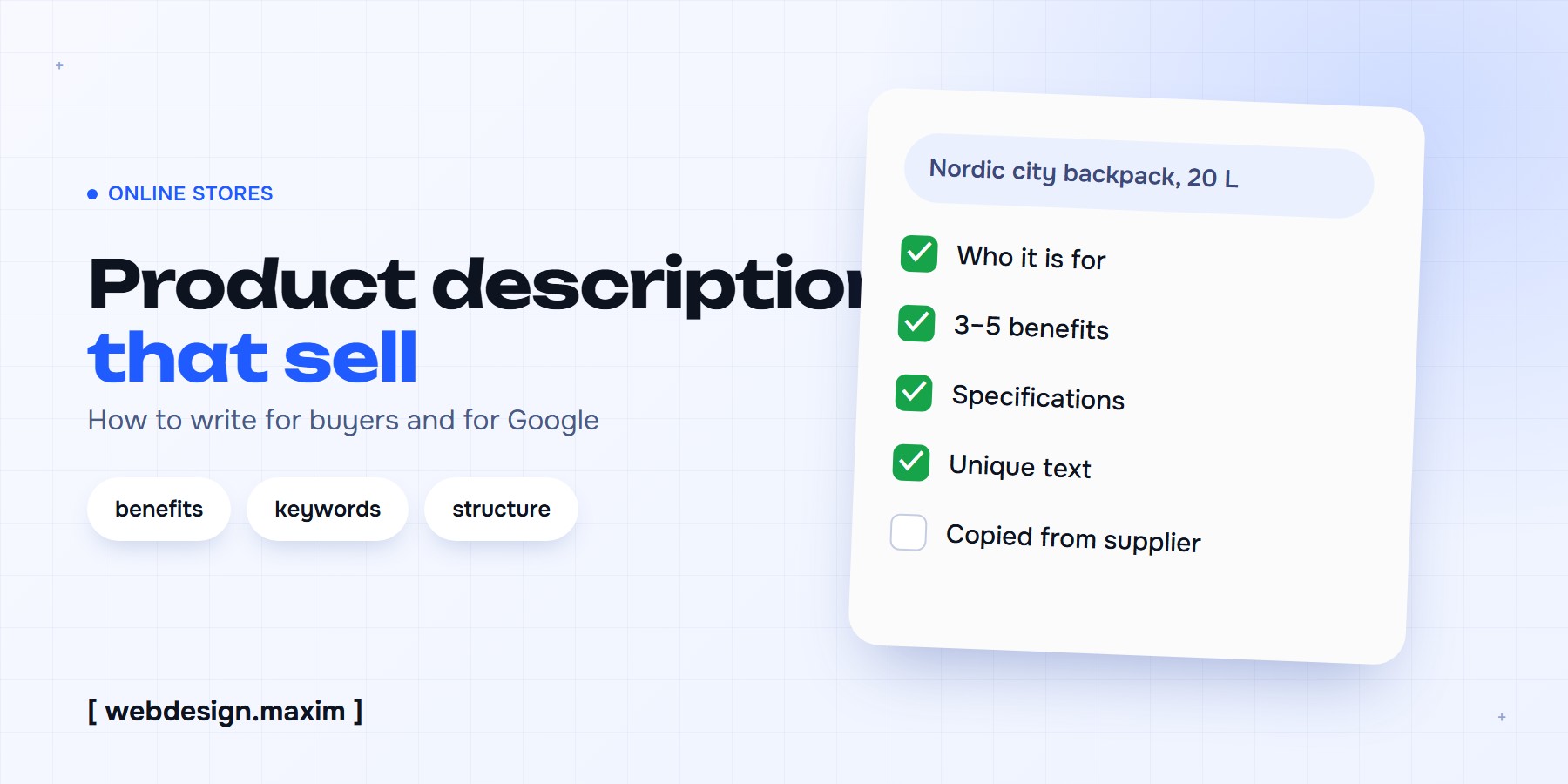
How to Write Product Descriptions That Sell and Rank
How to write a product description that sells and gets found on Google: structure, SEO rules, a before/after example, a checklist and common mistakes.
Product description: the short answer
A good product description answers three buyer questions: what it is, who it suits and why to buy it here. For Google it should include a clear name, the main query in a natural form, unique text and clear specifications. Write for people first, and then check that the page is clear to the search engine.
If you’re still putting your catalog together, first see the checklist “What you need to open an online store”.
Why a product description affects sales
A buyer can’t pick up the product. They go by the photo, price and text. If the description is empty, copied from the supplier or made of generic words, the person goes to a competitor who explains everything.
- For the buyer, the description removes doubts: size, material, compatibility, conditions of use.
- For search, the description helps understand what the page is about and show it for relevant queries.
- For the store, quality text reduces questions in messengers and returns because “it’s not what I expected”.
A structure that works
- Product name. Type, brand or model, the main characteristic. For example: “Nordic 20 L water-repellent city backpack”.
- The first paragraph (2–3 sentences). What the product is and who it’s for. Use the main query naturally here.
- Benefits. 3–5 points: what exactly improves the buyer’s life, not just “high quality”.
- Specifications. As a table or list: dimensions, material, weight, contents, country of origin, warranty.
- Who it’s for and how to use it. Scenarios: for travel, for school, for the office, as a gift.
- Terms. Shipping, payment, returns. Briefly, with links to the relevant pages.
- Call to action. “Add to cart” and “Ask for a consultation” next to the text.
Example: before and after
Before: “A quality backpack. Comfortable, fashionable, suits everyone. Buy in our store.”
After: “The Nordic city backpack, 20 liters, made of water-repellent fabric. It holds a laptop up to 15.6 inches, a bottle of water and a day’s belongings. It has a separate pocket for documents and soft straps, so it’s comfortable for daily city commutes. Weight: 650 g.”
The second version has specifics: volume, material, laptop size, weight. This helps a person decide and gives the search engine more clear details.
How to write for people
- Write about the benefit. “Water-repellent fabric” is a characteristic; “your things won’t get wet in the rain” is a benefit. It helps to give both.
- Use the buyer’s language. Don’t copy the supplier’s technical names if customers search differently.
- Answer typical questions. What’s in the box, whether it suits children, how to care for it. Collect them from customer messages.
- Don’t over-promise. If a product has limitations, it’s better to say so honestly. It reduces returns.
- Make the text easy to scan: short paragraphs, lists, key parameters in bold.
How to write for Google
- One main query per page. See how people search for the product: type, brand, model, characteristic. Add the query to the name, H1, first paragraph and meta tags, but don’t repeat it in every sentence.
- Unique text. Descriptions copied from a supplier or competitor give the page no advantage, because Google chooses which of the identical versions to show. Rewrite at least the key products in your own words.
- Title and description. Title up to 60 characters, description up to 155. They should include the product name, the main characteristic and a reason to click.
- One H1 on the page with the product name, then H2 for blocks (“Specifications”, “Shipping”).
- Image alt text. Briefly describe what’s in the photo: “Nordic backpack, black, front view”.
- Schema.org Product markup. It conveys the name, description, price, availability and reviews. On many platforms the theme generates it, but check it with Google’s Rich Results Test.
- Internal links. From categories to products, from products to related ones and to the shipping and payment pages.
How long a description should be
There’s no perfect character count. Go by the product and the buyer’s questions. A practical approach:
- Simple, low-priced products: short text and a clear specifications table.
- Complex or more expensive products: a detailed description with use scenarios, comparisons and answers to questions.
- Your most profitable items: write them first so they benefit from quality text.
Common mistakes in descriptions
- Copying from the supplier’s site without reworking.
- Generic phrases such as “high quality, affordable price” with no details.
- Keyword stuffing. The text reads unnaturally, and buyers leave.
- No specifications or they’re scattered through the text.
- The same description for different variants of a product (size, color) with no explanation.
- No shipping and return information next to the buy button.
What to do if you have hundreds or thousands of products
Writing every description by hand takes long. Then it’s convenient to work by priority:
- Start with the 10–20 products that bring the most sales or traffic.
- Create a description template with required blocks and the store’s tone.
- Prepare a table (CSV or Excel) with the fields: name, description, specifications, meta tags.
- Use AI as a drafting assistant, but check the facts and edit by hand.
- Import the updates to the platform and spot-check the cards on the site.
You can read about working with spreadsheets and imports in the article “How to move an online store to Horoshop or Shopify”, which covers data preparation using a real project.
A checklist before publishing a description
- The name includes the product type and the main characteristic.
- The first paragraph says what it is and who it suits.
- There are 3–5 benefits and a specifications table.
- The text is unique, not copied.
- Title up to 60 characters, description up to 155.
- The page has one H1, and the images have alt text.
- Information about shipping, payment and returns is nearby.
- The page looks good on a smartphone.
FAQ
How many words should a product description have?
There’s no universal number. A few sentences and specifications are enough for simple products; complex ones need a detailed text. Go by the buyer’s questions.
Can I copy a description from the supplier?
Technically you can, but such a page is no different from dozens of others. It’s better to rewrite the description in your own words, at least for the main products.
Can I write descriptions with AI?
Yes, as a draft. Always check specifications and facts, remove generic phrases and add details that aren’t in the ready-made text.
How many times should I use the keyword?
Enough for the query to sound natural in the name, H1, first paragraph and meta tags. Don’t count repetitions: go by readability.
Need help with your catalog?
Message me on Telegram or leave a request on the contact page. I’ll help plan the card structure, prepare import tables and set up meta tags. Details about the service: turnkey online store. The consultation is free.